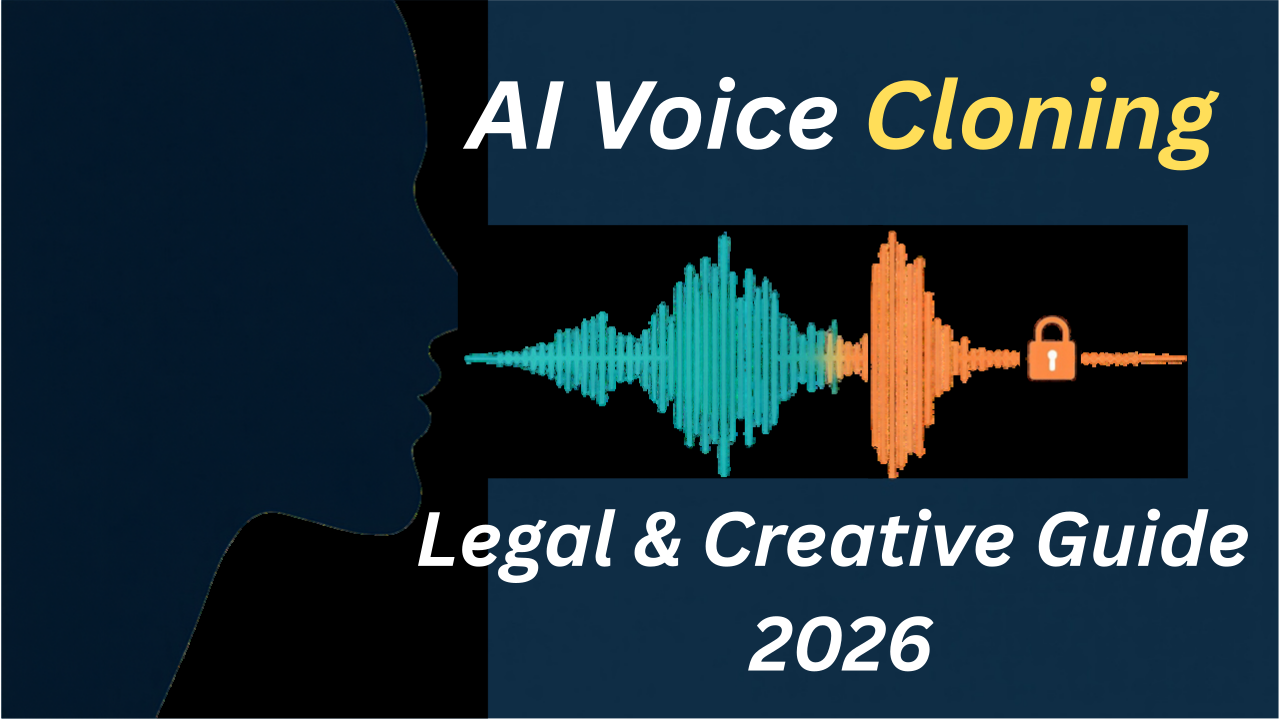
Some tools now need only a few seconds of audio to copy a voice well enough to fool the person's own mother. That's the part that makes headlines. The quieter part is that the same tech lets an author narrate a whole audiobook without forty hours in a studio, or lets a podcaster release one episode in ten languages. Both things are happening at once, and lawmakers are scrambling to keep up.
So here's the practical version: how to use voice AI creatively, what the law says in the US, EU and India, and where people tend to get burned.
Not all voice AI is the same
Plain text-to-speech with a stock voice is the harmless end. Nobody's identity is being copied, you just type and a generic voice reads.
A custom clone is different. A model is trained on recordings of one specific person, and that person might be you, an actor you hired, or someone who never agreed to anything. Voice conversion sits close to that: you talk, and the software turns you into somebody else.
Then there are sound-alikes, which imitate a famous voice without technically cloning it. This is the murky zone, and it's where most of the lawsuits live.
Almost every legal question comes back to four things. Whose voice is it? Did they agree? What are you doing with it? Did you tell your audience?
Using it well
Start with your own voice. It's the lowest-risk use and often the most useful: patch a mistake without re-recording, speed up narration, dub your content into other languages. YouTube's guidance even draws this line itself. Cloning your own voice for a voiceover doesn't need the "altered or synthetic content" label, while cloning someone else's does.
If you need a voice that isn't yours, license one. Voice actors now sell digital replicas on negotiated terms, and SAG-AFTRA's deals with companies like Narrativ and Replica Studios are built around consent, performer-set pricing and control over each use. A written licence with a clear scope is boring, and it's also what keeps you out of trouble.
A few habits make the results far better. Record your source audio in a quiet room, with the mic at a steady distance, because a clone can only be as good as its sample. Include some range, like questions, excitement and pauses, since a model trained on flat reading sounds flat everywhere. Regenerate single sentences instead of whole chapters. And listen to every minute before publishing, because odd stress on a word and mangled names slip through more often than you'd expect.
The legal map in 2026
There's no single global rulebook. What exists is a patchwork of publicity rights, consumer protection, telecom rules, contract law and a new wave of AI transparency duties.
United States
The US has no general federal right of publicity and no one law for voice cloning, so what protects a voice depends on the state.
Tennessee went first. Its ELVIS Act, signed in March 2024 and in force since July 1, 2024, protects a person's voice explicitly, including simulations of it. People can sue, misdemeanor penalties exist, and there's liability for distributing tools whose main purpose is making unauthorised voice or likeness copies. If you build or resell cloning tools, that last bit should catch your eye.
California took the contract route. AB 2602, effective January 1, 2025, makes a contract clause unenforceable if it lets a digital replica stand in for work a performer would otherwise do in person and doesn't describe the intended uses with reasonable specificity. In other words, "any use, any media, forever" language is a bad idea. AB 1836 covers digital replicas of deceased personalities, with at least $10,000 in damages.
On the federal side, the big one is the NO FAKES Act. The 2026 version (S.4591) would create a national right over a person's voice and likeness, with a takedown process and exceptions for news, commentary and parody. The Senate Judiciary Committee advanced it on June 18, 2026. As of the latest reporting I found, from September, it still isn't law and is waiting on the full Senate. Keep an eye on it, but don't plan around it yet, and check its status before you rely on this paragraph.
Two older federal tools matter as well. In February 2024 the FCC ruled (FCC 24-17) that AI-generated voices count as "artificial or prerecorded voices" under the Telephone Consumer Protection Act, so calling people with a synthetic or cloned voice generally needs their prior consent. And the FTC's impersonation rule, in effect since April 2024, covers deceptive impersonation of government bodies and businesses. Cloned-voice scams can also be charged as plain old fraud.
European Union
Article 50 of the EU AI Act started applying on August 2, 2026, and it splits the work in two. Companies that build generative systems must mark their output in a machine-readable way, so software can tell it's synthetic. People who publish a deepfake, which includes realistic audio imitating a real person, must say it's artificially generated or manipulated.
Clearly artistic, satirical or fictional work gets a lighter touch, and the disclosure shouldn't ruin the work itself. Fines can reach €15 million or 3% of global turnover. The Commission also published a voluntary Code of Practice on labelling in June 2026.
Two warnings. A label doesn't make an unlawful use lawful, since you still need consent under personality-rights and data-protection law, and voice data can count as personal or even biometric data under GDPR. Also, none of this depends on where you live. If your audio reaches people in the EU, it applies to you.
India
India's IT Rules were amended in 2026, with the changes notified on February 10 and in force from February 20. They introduce a definition of "synthetically generated information," which covers deepfakes and AI-cloned audio. Under the rules, synthetic content has to be clearly and prominently labelled, platforms must ask users to declare whether something is synthetic, provenance metadata is encouraged so content can be traced, and flagged unlawful content has to come down within three hours or the platform risks losing its safe-harbour protection.
Posting AI audio isn't banned. You should just expect to declare and label it. Impersonation, fraud and non-consensual intimate content stay illegal under existing Indian law whether or not they're labelled.
Platforms
Platforms are often stricter than the law. YouTube wants disclosure for realistic synthetic content, including cloning another person's voice or making a real person appear to say something they didn't, and creators who keep skipping it can lose monetisation. Its "inauthentic content" policy also goes after mass-produced, low-effort AI uploads. A synthetic voice by itself won't block earnings, but a channel with no original value can.
Consent settles most disputes
Look at nearly any case and the same questions come up. Could a listener recognise the voice as a specific person? Did that person give informed, specific consent, covering uses, duration, territory and pay? Is the use commercial, deceptive or harmful? Ads, endorsements and impersonation are the dangerous ones, while parody and news have better defences, though never automatic ones. And did you tell the audience? That's now both a legal duty in places and a platform rule.
If you license a voice, get the key points in writing: who owns the recordings and the model, exactly what uses are allowed ("narration of Title X," not "all media"), territory and duration, payment, how either side can opt out, deletion of the model and recordings when the deal ends, and how the model will be stored securely. Specific wording protects both sides, and under California's AB 2602 it's close to mandatory.
Quick risk guide
A short checklist
Write down whose voice you're using.
Get written, specific consent from every real person involved.
Pick a vendor that verifies consent and supports watermarking or provenance data.
Label synthetic audio where it's required, and honestly, consider labelling it everywhere.
Keep consent forms, contracts and generation logs.
Stay away from public figures and sound-alikes unless you hold a licence.
Have a fast takedown process for complaints.
Check the law where your audience is, and re-check pending bills like NO FAKES every few months.
Protecting your family from voice scams
Scammers can grab a short clip from social media, clone a relative's voice and call you with a made-up emergency. The FTC's advice has stayed consistent. Don't trust the voice alone, and hang up and call back on a number you already know. Agree a family safe word that isn't online and isn't guessable, and ask for it in any emergency call, which the FBI and FTC both recommend. Treat urgency and odd payment methods like gift cards, wire transfers and crypto machines as red flags. If it happens, report it: ReportFraud.ftc.gov in the US, or 1930 and the national cybercrime portal in India.
FAQ
Is AI voice cloning legal? The technology is. What matters is whose voice it is, whether they agreed, how you use it and whether you disclose it.
Can I clone a celebrity for a parody? Parody gets some protection in many systems, but there's no guarantee. Label it clearly, avoid anything that could pass as a real statement, and keep it out of ads.
Do I have to label AI audio? More and more, yes. The EU requires it from August 2, 2026, India requires it on platforms since February 2026, and YouTube asks for it on realistic synthetic content.