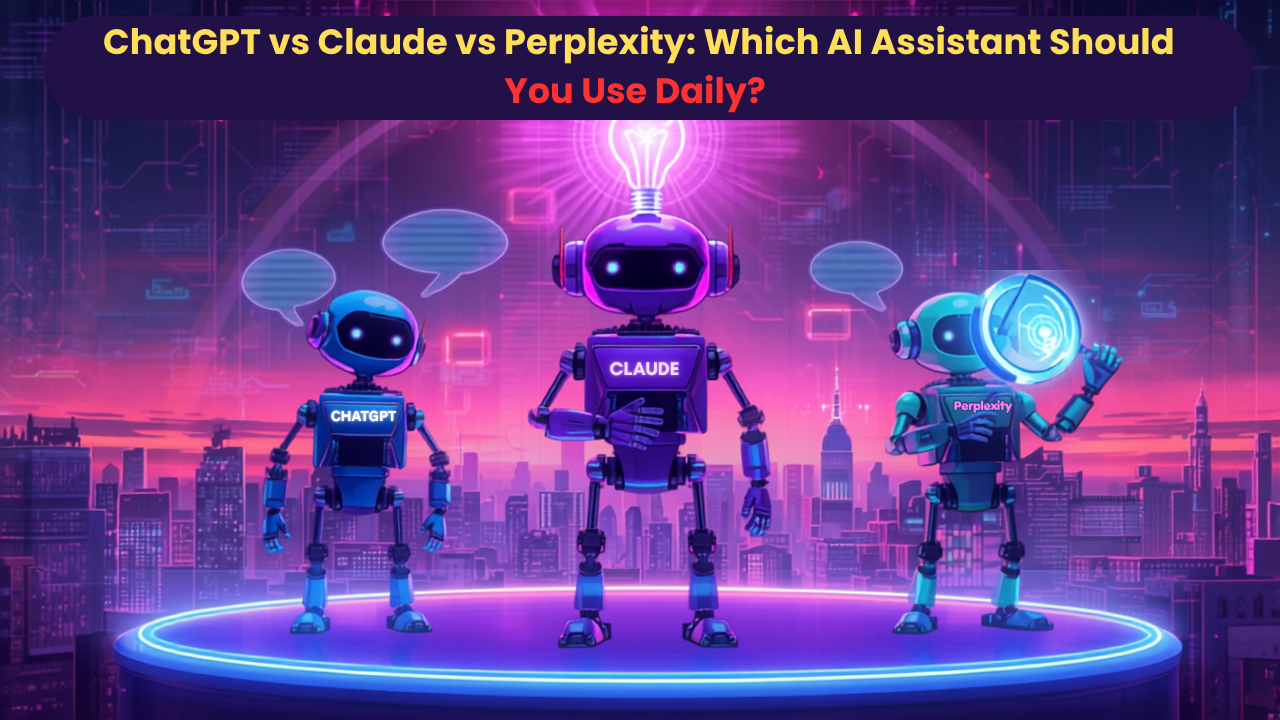
People often ask me which of the three they should spend their money on. And to be honest, my answer usually leaves them a little disappointed because I don’t pick just one name. Right now I’m paying for two subscriptions and I open the third one almost every day. So in this article I’m not going to give you some boring comparison table. I’ll just tell you straight which app I open for what kind of work, where I’ve run into problems, and which one I’d keep if I could only keep one.
First, let me be clear — this field changes every week. Model names change, prices go up and down. So treat whatever I’m writing here as a snapshot of today, not permanent truth.
ChatGPT is the first one I open, without thinking
You have to admit it — whenever someone says “AI chatbot,” most people’s minds jump to ChatGPT first. And there’s a reason for that. It has a little bit of everything. I use it to generate images when I need a quick visual for a presentation, I use voice mode when I’m walking on the road and just thinking out loud, and sometimes even for tiny tasks — like rewriting a WhatsApp message so it doesn’t sound rude.
The problem shows up in its confidence. It answers things it has no idea about with the same loud certainty as things it knows 100%. Once it made up a statistic that sounded completely correct, but when I checked the source there was nothing like it. It wasn’t malice — it’s just overconfident. If you’re using it for something you’re going to publish or send to a client, always double-check the facts yourself. Don’t trust it just because it sounds sure of itself.
The agent-style features have also gotten quite good now — browsing, running code, doing multi-step work on its own. If you want one single app that can try almost everything, this is that app.
Claude is what I open when the work is serious
This might sound a bit like favoritism, but it’s the truth. When the work actually matters — a long document, editing something instead of writing from scratch, code that’s going to ship — I open Claude. It needs less hand-holding than the other two.
One thing I only properly understood after using it for a long time: it doesn’t pad its answers. Sometimes when you ask ChatGPT, you get three paragraphs of introduction before the real answer. Claude gives you the answer straight, and if it doesn’t know something it says so — it doesn’t guess without telling you.
To be fair, it has one big limitation — it doesn’t generate images at all, and its integrations are fewer compared to OpenAI. If a big part of your daily work is generating images or connecting different apps, you’ll feel that gap.
Perplexity is what I open when I need to check something before believing it
Honestly, Perplexity doesn’t get talked about as much as the other two, and I think that’s a mistake — at least for the way I use it. Every answer comes with sources right there, ready to click. When I need to fact-check some news or understand what actually happened rather than what people are saying, this is the tool that works. I ask a question, get an answer, and in ten seconds I can click the source and verify it — no need to open ten extra tabs.
It’s not my first choice for creative writing or brainstorming. If you try to get it to write a birthday card it will feel like asking a librarian to write a poem. That’s not its job, and it doesn’t pretend to be. But for those “what does the source actually say” moments, I haven’t found anything like it yet.
So where should you spend the money?
If you can only afford one subscription, my honest advice is this — think about what you do every day, not what you might need once in a while.
If your daily work involves writing or handling long documents, take Claude. It doesn’t lose structure even in long pieces.
If you want one flexible app — images, quick answers, brainstorming, voice, everything — take ChatGPT. It’s a generalist and it’s good at being a generalist.
If your days are spent on research, current events, or verifying things, take Perplexity. Having sources attached is hard to beat.
And if you’re like me and can stretch to two subscriptions — that’s the sweet spot most heavy users eventually land on. One for thinking and writing, the other ready for when you need to see the source before you believe something.
None of them is the “best AI.” All three are built for different jobs, and the frustration starts the moment you expect one tool to do something it was never designed for.
Conclusion
In the end, the real question isn’t which AI is “the best.” It’s which one fits the kind of work you actually do every day. ChatGPT is the versatile all-rounder, Claude is the thoughtful specialist for serious work, and Perplexity is the reliable fact-checker with sources attached.
Most people don’t need just one — they need the right combination. Start with the tool that matches your daily workflow, and only add a second if you genuinely feel the gap. The tools will keep changing, but the principle stays the same: use the right tool for the job, and don’t force one AI to be everything.
Summary Recommendation
| Primary Use Case | Top Recommendation | Key Advantage |
|---|---|---|
| Deep Coding & Refactoring | Claude 3.5 Sonnet | Superior code logic and interactive Artifacts pane |
| Live Fact-Checking & Market Research | Perplexity AI Pro | Direct web citations and zero hallucination friction |
| Multimodal Data, Voice & Versatility | ChatGPT Plus | Advanced Data Analysis, Canvas, and Voice Mode |